
Rethinking air management in papermaking
Reducing chemicals by reducing chemicals
One way to reduce chemical consumption in papermaking is simply to remove the reason why some of those chemicals are needed in the first place.
That was the starting point for our paper Reducing Chemicals by Reducing Chemicals, presented at ABTCP 2026, and subsequently selected among the ten papers highlighted by the ABTCP congress committee.
Behind the slightly provocative title is a rather practical idea: instead of controlling air-related problems with chemicals, what if we remove the air mechanically, as early as possible?
Air is more than bubbles and foam
Air in the wet end of a paper machine can easily be underestimated. We tend to notice air when we see foam, but its impact goes much further.
Entrained air in the short circulation can have an impact on retention and dewatering, formation, sheet breaks and pinholes, pressure pulsations, energy consumption and the performance of process chemicals.
The situation is becoming increasingly demanding. Modern machines operate at high speeds, recycled and more challenging furnishes introduce impurities and variability, while expectations for both paper quality and production efficiency remain high.
In other words, expectation is to have extremely stable process while operational conditions are promoting instability.
When solving one problem creates another
The traditional response to air and foam is often chemical. Defoamers and deaerators can be effective tools for controlling foam and bubble behavior. But wet-end chemistry is an interconnected system.
Surface-active foam-control chemicals may affect the performance of other additives involved in retention, strength, sizing, coloring and chemical fixation. If the performance of one chemical is affected, the natural reaction is to adjust the dosage of it, which again affects the function of other chemicals. The result can be an increasingly complicated chemical environment where more is not the merrier.
This led us to ask a simple question: Could we break this cycle by removing the air instead?
Remove air where it enters the system
There are several approaches to deaeration. Air can be controlled chemically or removed through passive, partial or active deaeration systems. The important question, however, is not only how much air is removed, but also when it is removed.
Our paper focuses on compact short circulation with early mechanical deaeration.
The principle is to remove air immediately after it enters the white-water system instead of allowing air to circulate through much of the process before removing it close to the headbox. The approach described in the paper combines vacuum-assisted degassing with centrifugal force and addresses both entrained and dissolved air.
This changes the thinking from treating a symptom to addressing its cause.
Why timing matters
Air bubbles are surprisingly active participants in the wet-end environment.
To put their scale into perspective, the paper uses an example of white water containing 1% air by volume with bubbles approximately 100 µm in diameter. That represents roughly 600 m² of bubble surface area in just one cubic meter of white water.
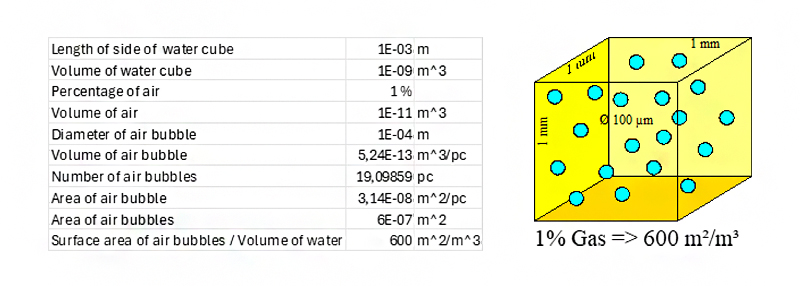 Example of gas bubbles' surface area per white water volume. (Picture roughly in scale, correct number of right size bubbles illustrated!)
That is a substantial interface within the process.
Contaminants, ink particles and micro stickies can attach to bubble surfaces. As pressure changes through the process, bubbles can shrink and eventuallydissolve, leaving “passengers” behind. When pressure drops, tiny bubbles can form again andand a new set of contaminants is collected onboard. .
Removing air early therefore means more than simply getting rid of visible foam.
Less air, less chemistry, more stability
This brings us back to the title: Reducing Chemicals by Reducing Chemicals.
When mechanical deaeration reduces the requirement for defoamers and deaerators, one source of interaction within wet-end chemistry is reduced as well. Depending on the application and process conditions, this can potentially allow other wet-end chemicals to perform more predictably and reduce overall chemical demand.
The benefits described in the conference material can include reduced or eliminated use of defoamers and deaerators, lower demand for selected wet-end chemicals, more predictable sizing and retention performance, improved runnability and greater process stability. And for me, this is the interesting part.
The objective should not necessarily be to find another chemical that solves a problem. Sometimes the better question is:
What is causing us to need that chemical in the first place?
If air is part of that root cause, removing it mechanically and early can simplify the whole process.
That is ultimately what we mean by reducing chemicals by reducing chemicals: remove the root cause before it creates the need for chemical compensation.

About the Author

Jukka Heinonen, Product Manager
One could say I have been gone by the flow for all my career. After many years with process valves, more than decade with wastewater pumps, some years with valve controllers and municipal water management, I finally landed to Aikawa Fiber Technologies in 2022. Coming into pulp and paper industry with mech D&E and project background has been surprisingly smooth, as support from our hard-core P&P professionals has been there all the time.
My main responsibilities cover Product Manager’s duties related to POMp Degasser product family and currently my scope is extending to other POM products as well. This equipment, together with our deep in-house process knowledge, form a backbone for our unique POM approach flow system. Whatever process challenge you might have at your mill, we are here to help you with our innovative solutions. All this is done through our AFT values, Respect, Collaboration, Ambition, Trust and Knowledge.