Lower Total Cost of Ownership Starts with Better Fiber Development
Lower Total Cost of Ownership Starts with Better Fiber Development
In today's pulp and paper industry, success is no longer measured by the performance of individual components alone. Mills are expected to produce higher-quality products while reducing energy consumption, maximizing equipment availability and operating with tighter maintenance budgets.
In this environment, purchasing decisions increasingly focus on one key metric: Total Cost of Ownership (TCO).
When it comes to low consistency refining, the purchase price of refiner plates represents only a fraction of the overall cost. Energy consumption, maintenance intervals, downtime, paper quality, fiber utilization and production efficiency all have a far greater impact on the economics of the refining process.
Reducing TCO therefore requires more than durable wear parts. It requires a refining solution that optimizes the entire process. At AFT, this philosophy has guided the development of the Finebar® technology for nearly three decades.
Pillar One: Better Fiber Development
The purpose of refining is not simply to consume energy — it is to develop fibers to its full potential, required to optimize final paper product cost, PM runnability and enable uniform product quality/higher-quality paper.
Traditional high-intensity refining achieves this by applying large impacts to the fibers. While effective in changing furnish drainage, excessive intensity can shorten fibers, generate fines and consume unnecessary energy.
AFT Finebar® follows a different philosophy.
By increasing the number of bar crossings and lowering the Specific Edge Load (SEL), refining energy is distributed more evenly across the fibers. Instead of cutting fibers, the process promotes the gentler external fibrillation, increasing fiber flexibility and bonding potential while preserving fiber length.
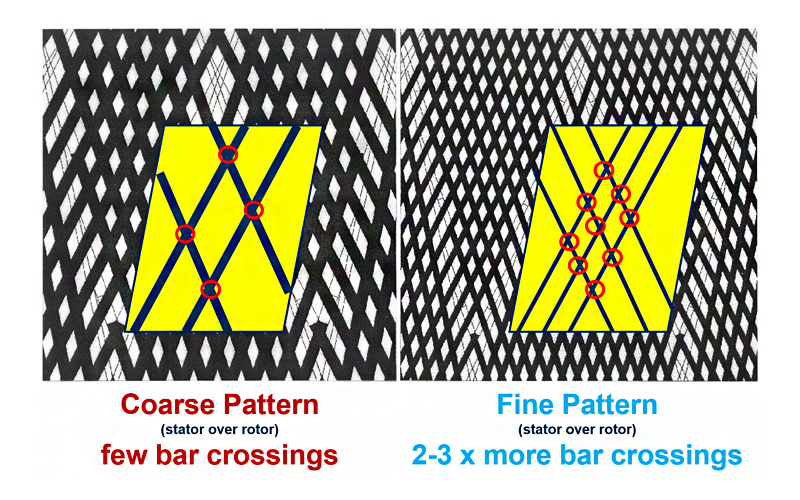
Figure 1: Impact of pattern design on number of bar crossings
The result is not only improved dewatering behaviour, but also improved paper strength and bulk, higher energy efficiency and, in many applications, reduced chemical consumption as well as increased lifetime.
For mills, better fiber development means achieving production targets with fewer resources.
Pillar Two: Mill-Tailored Plate Design
No two refining applications are identical.
Different furnishes, production targets, machine/system configurations and operating conditions all require tailored refining strategies. A plate design that performs well in one application may not be optimal in another.
This is why AFT does not rely on standard catalogue patterns or designs.
Finebar® plates are engineered specifically for each application, combining process knowledge with advanced manufacturing technology to optimize pattern geometry, hydraulic capacity and refining intensity.
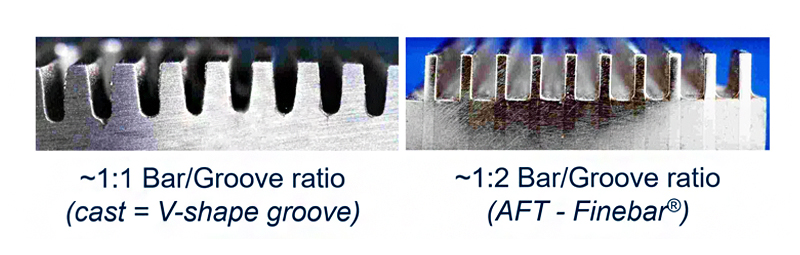
Figure 2: Impact of pattern geometry on hydraulic capacity
Using precision laser-cut stainless-steel components and diffusion bonding technology, Finebar® plates offer exceptional design flexibility that allows AFT engineers to tailor each solution to the customer's process and needs.
The objective is never simply to replace or copy existing plates. It is to develop the optimum refining solution for the mill specific conditions.
Pillar Three: Longer Service Life Through Advanced Manufacturing
Lower TCO depends not only on refining performance but also on equipment durability.
Every plate replacement requires maintenance resources, inventory, downtime and production interruptions. Extending service life therefore creates value throughout the operation.
Finebar® plates are manufactured using precision laser-cut components joined through diffusion bonding. This process produces a dense, high-strength metallurgical structure with excellent wear resistance while maintaining precise bar geometry throughout the plate's operating life.
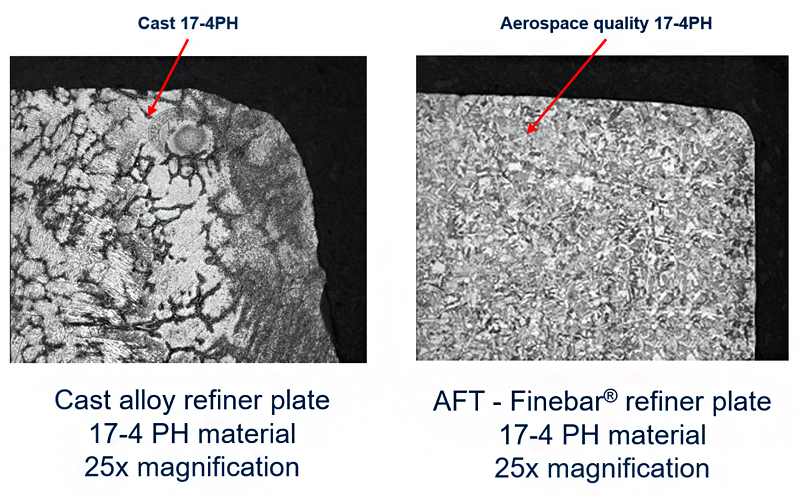
Figure 3: Metallurgical difference between casting vs. fabrication impacts wear resistance, and leading-edge rounding
The result is longer-lasting consistent refining performance, reduced leading-edge rounding and improved resistance to mechanical impacts.
For demanding abrasive applications, AFT also offers EdgeGuard™ technology — a proprietary wear-resistant treatment.
By protecting the area exposed to abrasion, EdgeGuard™ extends plate life while maintaining refining efficiency over longer operating periods.
Longer plate life means:
- fewer maintenance shutdowns,
- lower replacement costs,
- reduced spare parts inventory,
- more consistent refining performance, and
- lower lifecycle costs.
These benefits contribute directly to reducing the Total Cost of Ownership of the refining operation.
Proven Across a Wide Range of Applications
The benefits of this three-pillar approach have been demonstrated in hundreds of installations worldwide across bleached and unbleached hardwood and softwood chemical pulps, OCC, DIP, NSSC, mechanical pulps and non-wood fibers.
Customer results include:
- improved paper strength and bulk as well as dewatering behaviour,
- significant reductions in refining energy,
- extended plate life,
- lower maintenance requirements,
- increased production capacity,
- furnish substitution potential,
- reduced chemical consumption, and
- measurable reductions in greenhouse gas emissions.
For example, one OCC mill more than doubled plate life while reducing no-load power consumption by 23%, saving approximately 400,000 kWh annually. Other mills have achieved up to three times longer plate life together with improved paper properties and lower refining energy.
Although every application is unique, the principle remains the same: optimizing the refining process delivers value far beyond the refiner itself.
A Lifecycle Partner for Continuous Improvement
Technology alone does not guarantee better results.
Successful refining requires understanding the interaction between fibers, equipment and process conditions and its impact on the end product characteristics. This is why AFT combines Finebar® technology with process audits, application expertise and close collaboration with customer teams.
Rather than focusing on individual components, AFT evaluates the complete refining process to identify opportunities for improving efficiency, quality and operating costs.
This collaborative approach enables mills to continuously optimize performance while adapting to changing raw materials, production targets and market demands.
Better Fiber Development. Lower Total Cost of Ownership.
For nearly 30 years, AFT Finebar® technology has been helping mills improve refining performance through a simple but powerful philosophy: Develop the fiber. Tailor the solution. Extend the life.
These three principles work together to reduce energy consumption, improve paper quality, increase equipment availability and lower maintenance requirements.
The outcome is more than better refining — it is a lower Total Cost of Ownership across the entire refining operation. The true value of refining is measured not by the cost of the plate, but by the value it creates throughout the mill.

About the Author
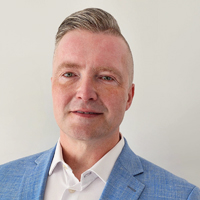
Jens Heymer (Ph.D.), Product Director - Fiber Development, AFT
I became part of Aikawa Fiber Technologies in 2011 and now hold the position of Product Director - Fiber Development for the Finebar low-consistency (LC) refiner plate as well as conical filling business. In this position, I manage product development from conceptualization, design to production and launch.
Being involved in the P&P industry since 1996 provided the background and understanding that enables me to identify / prioritize product features that align with our clients’ needs and deliver measurable results in an ever-changing marketplace. I am very passionate about LC refining and creating innovative products that solve real-world TCO problems.